Vietnam Hardware Sourcing Complete Guide 2026
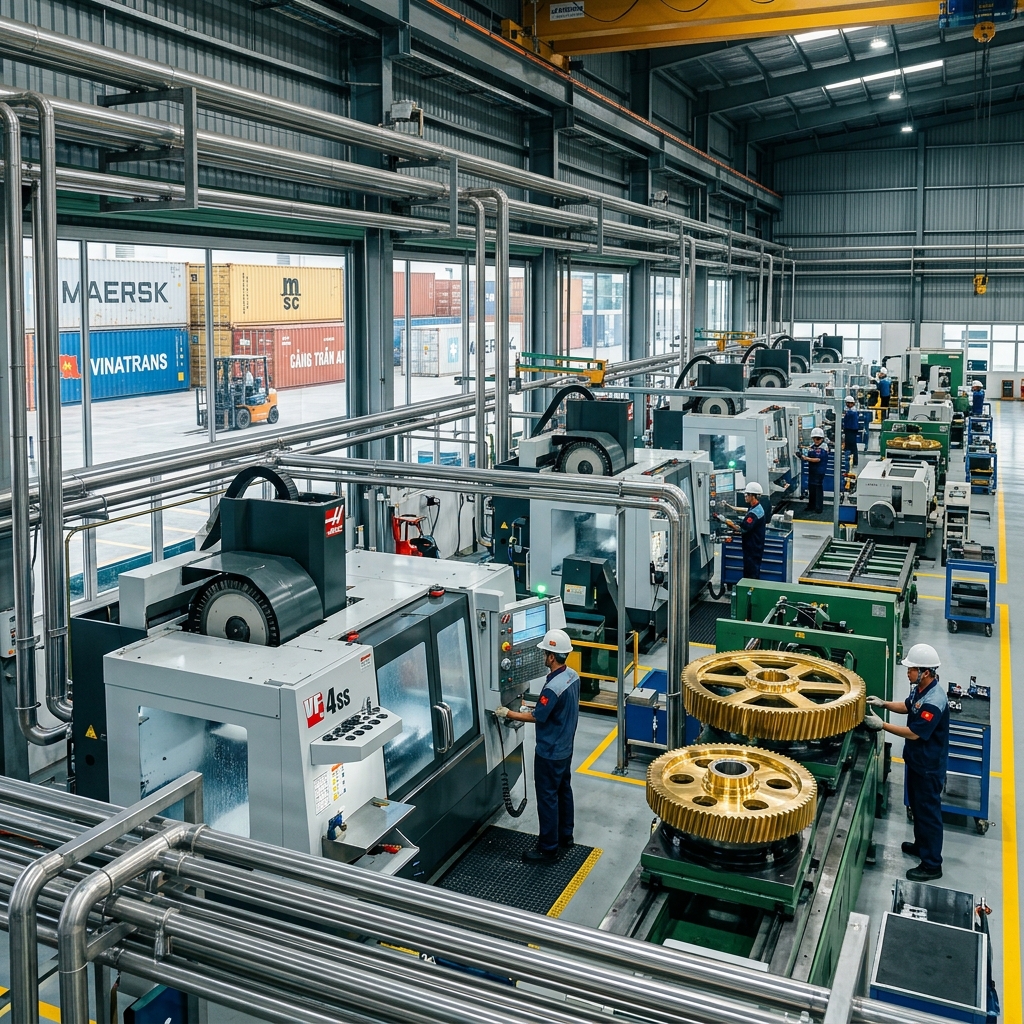
Key Stats — Vietnam Hardware Sourcing 2026
- $24.8 billion Vietnam manufacturing FDI in 2024 (Ministry of Planning and Investment)
- 40-55% lower unit labor cost vs coastal China ($280-$350 vs $700-$900/month)
- 15+ active FTAs including CPTPP, RCEP, EVFTA, UKVFTA, VKFTA
- 3,000+ foreign-invested manufacturers in Binh Duong province alone
- 63 provinces, 300+ industrial zones, 12,000+ verified suppliers indexed on VinHardLink
Vietnam Hardware Sourcing Complete Guide 2026
Vietnam has become the second-most-popular China+1 manufacturing destination for global hardware buyers, behind only Mexico. The numbers tell the story: foreign direct investment into Vietnamese manufacturing hit a record $24.8 billion in 2024 (per the Ministry of Planning and Investment), and hardware-related subsectors (fasteners, aluminum extrusion, stamped parts, die-casting) grew faster than the national average.
But opportunity brings noise. With 63 provinces, 300+ industrial zones, and 12,000+ verified suppliers indexed on VinHardLink, a first-time buyer can easily pick the wrong partner and lose 3-6 months recovering.
This guide covers the six things that actually matter: why Vietnam, where to look, what to verify, what to demand in writing, what to avoid, and how to move from search to signed contract.
1. Why Vietnam for hardware
Three structural advantages make Vietnam hard to ignore:
- Labor cost gap. Average factory wage in southern Vietnam runs $280-$350/month versus $700-$900 in coastal China. Even accounting for productivity differences, unit labor cost is typically 40-55% lower.
- Trade agreements. Vietnam is party to 15+ active FTAs including CPTPP, RCEP, EVFTA (EU), UKVFTA, and VKFTA (Korea). For exports to the EU, UK, Japan, Korea, Canada, or Australia, tariffs are often lower from Vietnam than from China.
- Ecosystem maturity. Decades of FDI from Taiwan, Japan, and Korea built real hardware capacity. Binh Duong alone hosts 3,000+ foreign-invested manufacturers. Skilled technicians exist; English-speaking project managers are findable.
What Vietnam is not good at yet: high-precision PCB assembly, large-scale plastic injection with automation, and rare-earth-dependent processes. For those, China still dominates.
2. Where to look: the four hardware clusters
| Cluster | Strengths | Key zones |
|---|---|---|
| Binh Duong + Dong Nai | Fasteners, aluminum extrusion, die-casting, surface treatment | VSIP I/II, Amata City, Song Than |
| Ho Chi Minh City | Trading, logistics, finishing, smaller precision shops | Tan Thuan EPZ, Hiep Phuoc IP |
| Hanoi + Bac Ninh + Hai Phong | Precision stamping, sheet metal, Samsung/LG supply chain | VSIP Bac Ninh, Thang Long IP, DEEP C |
| Central coast (Da Nang, Quang Nam) | Lower-cost labor, emerging | Chu Lai Open EZ |
For most hardware buyers, Binh Duong is the default: concentration of Taiwanese and Japanese factories, mature supplier base, English-speaking sales reps more common than elsewhere. For precision-stamped parts or sheet-metal work feeding Samsung/LG, the northern cluster is stronger.
3. Certifications that actually matter
ISO 9001 is table stakes. If a supplier cannot show a current certificate PDF, walk away. Beyond that, match the certification to your end customer:
- IATF 16949 — required for automotive OEM/Tier 1 supply
- ISO 14001 — environmental management, increasingly required by EU buyers
- CE marking + RoHS + REACH — required for any product sold in the EU
- JIS — Japanese Industrial Standards, expected by Japanese OEMs
- UL — required for products sold into the US market in regulated categories
- SEDEX / BSCI / SA8000 — social compliance audits, required by large retailers (Walmart, IKEA, H&M)
A supplier claiming five certifications but unable to produce current PDFs is not certified. Expired certificates are as useless as none.
Want to skip the cold outreach? Filter verified suppliers by certification and province, then send a structured RFQ to your top candidates.
4. Red flags when reviewing supplier profiles
After reviewing thousands of supplier profiles, the same warning patterns repeat:
- No tax registration number. Cross-check at masothue.com. Any legitimate manufacturer has a visible MST (mã số thuế).
- Factory photos that reverse-image-search to other companies. Trading companies stock their websites with stock factory imagery. Run a Google reverse image search on the photo before engaging.
- Only mobile phone, no landline. Factories have fixed lines; pure trading agents often don't.
- Claims certifications but cannot send the PDF within 24 hours. If it took a week to "find," it doesn't exist.
- Factory address that is a residential block or shared office. Google Street View the address. Real factories have visible industrial buildings, truck access, worker dormitories nearby.
- Minimum order quantity that seems designed to discourage questions. MOQ 100,000 pieces on a first inquiry is often a filter for tourists, not a real constraint.
5. What to demand before sending a deposit
- Production floor photos with timestamp. Ideally video walkthrough.
- Certificates PDF with verifier QR code or registry number you can cross-check.
- Tax registration screenshot from masothue.com matching the company name on the contract.
- Signed NDA before sharing detailed technical drawings.
- Third-party inspection clause in the purchase order (SGS, Bureau Veritas, or Intertek at final random inspection before shipment).
- Payment terms: 30% deposit, 70% after inspection clears. Never 50% deposit on a first order.
- Golden sample contractually tied to acceptance criteria. The sample you approve becomes the production standard.
6. How to use VinHardLink to compress the search
VinHardLink is built for this workflow:
- Filter suppliers by province + certification + nationality of investment (TW, JP, KR, CN, VN). This alone cuts a 12,000-supplier database to 50-200 candidates.
- Cross-reference Google Maps ratings — we pull real ratings and review counts.
- Check verification status — suppliers with VinHardLink verified badges have been cross-checked against masothue.com.
- Send RFQ to top 3-5 candidates via the RFQ board. Verified suppliers bid; you compare quotes side-by-side.
- Visit before signing. Even the best profile cannot replace a physical visit. Budget 3-5 days in Vietnam to meet 6-8 shortlisted suppliers in person.
For a deeper read on regional tradeoffs, see our HCMC vs Hanoi cluster comparison and seven negotiation traps to avoid.
Published by VinHardLink. For real-time Vietnam supplier data and verified contacts, visit vinhardlink.com.