Vietnam Hardware Factory Audit SOP for Foreign Buyers 2026
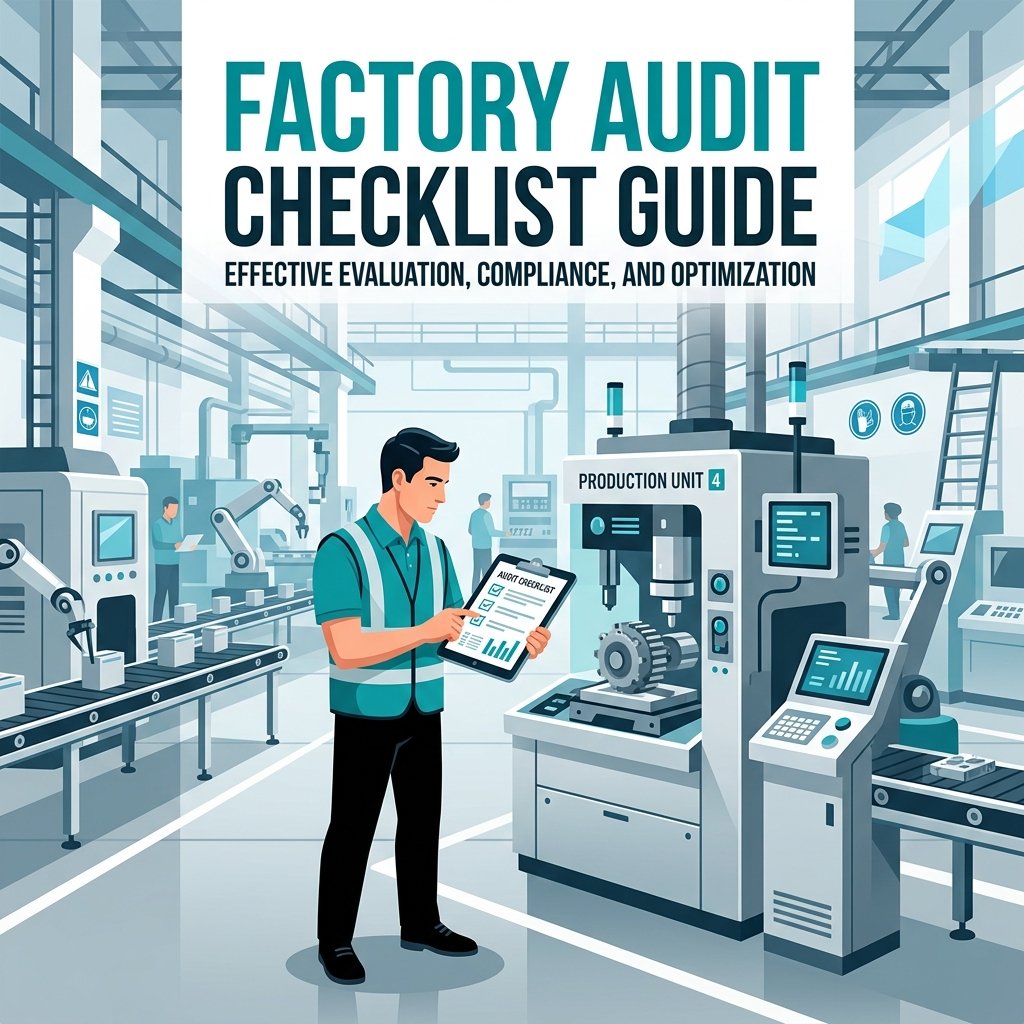
Key Stats — Vietnam Hardware Factory Audit SOP
- Third-party audit cost: QIMA / SGS / Bureau Veritas full-day audit $300-$800; AQF / V-Trust mid-tier $200-$500
- In-house audit cost: foreign procurement staff flights, lodging, translator, transport — $3,000-$5,000 per 3-day trip
- Trading-company-posing-as-factory rate: industry-dependent, hardware estimated at 20-35%
- First-pass audit success rate: roughly 40-60% (rest require corrective action and re-audit, or supplier swap)
- Golden sample contract clause is now industry standard — without it, post-shipment quality disputes have no legal basis
Vietnam Hardware Factory Audit SOP for Foreign Buyers 2026
Every experienced Vietnam buyer has the same story: the supplier nailed the RFQ, the sample passed, then the first production run hit the floor and quality fell apart. A factory audit is the only reliable way to convert a "paper supplier" into a real partner.
This guide is a complete factory audit SOP — pre-audit data prep, on-site evaluation checklist, and the report-and-decision framework — for foreign buyers with the resources to either send their own staff or commission a third party.
1. Pre-audit preparation (D-14 to D-3)
Two weeks before the audit, collect and verify the documents below. If the supplier cannot produce any single item, skip the audit.
| Document | Purpose | Source |
|---|---|---|
| Vietnam tax code (MST, 10 digits) | Verify on masothue.com — confirm the company exists and the registered industry matches | Supplier |
| Business registration certificate (GCN ĐKKD) copy | Verify registered capital, legal representative | Supplier |
| ISO / IATF certificates PDF (with issuer and certificate number) | Cross-check on the issuing body's website | Supplier |
| Past 2 years export records | Confirm real export experience | Supplier or Vietnam customs public data |
| Factory address + Google Street View | Verify there's actually an industrial building (not residential / shared office) | Google Maps |
| Top customer list with contacts | Reference calls (at least 1-2) | Supplier |
| Past 12 months complaint / RMA log | Quality management system actually running | Supplier |
Reference call script: "Hi, we're evaluating XX Company as a Vietnamese supplier. How many times has your company worked with them? When was the most recent order? Anything to improve on quality or lead time?" Real customers give specific answers; fake customers stay vague.
2. Third-party audit vs in-house: how to choose
| Dimension | Third-party | In-house |
|---|---|---|
| Cost | $300-$800/day | $3,000-$5,000/3 days (flights + lodging) |
| Objectivity | High (no skin in the game) | Medium (procurement staff may have bias) |
| Technical depth | Varies, strong on QC, weak on your specific tech | Your engineers know your specs best |
| Vietnam local know-how | QIMA/SGS/AQF all know Vietnam | First trip carries learning cost |
| Report format | Standardized, comparable | Custom, deeper |
Recommended combination:
- First engagement: third-party baseline audit (~$500) to filter out trading-company impostors
- Pre-production: your own engineer for PPAP (Production Part Approval Process) + process confirmation
- In production: quarterly third-party random FRI (Final Random Inspection)
Major third-party inspection bodies in Vietnam (by office density):
- AQF (Asia Quality Focus) — HCMC + Hanoi offices, SME-friendly
- V-Trust — China + Vietnam dual base, Mandarin BD
- QIMA — global brand, expensive
- HQTS — Hong Kong veteran, Taiwan office
- SGS / Bureau Veritas / TÜV — enterprise-process firms, fit for large buyers
3. On-site evaluation checklist (6 domains)
3.1 Capacity
- Monthly production capacity (compare to RFQ commitment — commonly inflated 2-3x)
- Major equipment list with model numbers (photo for record)
- Equipment vintage (verify age)
- Total headcount / direct production workers / shift pattern
Red flag: RFQ said "1M pcs/month" but you see 3 production lines and 50 workers — usually trading forwarding orders to other factories.
3.2 Quality control
- IQC (incoming inspection) sampling and standard
- IPQC (in-process inspection) station count and frequency
- FQC (final inspection) standard and equipment (test instruments, gauges)
- Non-conforming product handling (quarantine area, scrap vs rework criteria)
- SPC (Statistical Process Control) chart usage
Red flag: QC department of 2-3 people claiming 50,000 pcs/day output = sampling rate too low, production quality unstable.
3.3 Equipment and technology
- Critical equipment brand and vintage (CNC, injection molding, stamping, surface treatment)
- Equipment maintenance records
- Tooling library management (numbering, cleaning, maintenance log)
- Calibration records (gauges and instruments sent for external calibration regularly?)
3.4 Workforce
- Worker skill grade distribution
- Training program (onboarding, skill upgrade)
- Annual turnover rate (high = quality instability)
- Wage level (too low = high turnover + social compliance risk)
3.5 Safety and environment
- Fire safety equipment (extinguishers, hydrants, emergency exits)
- Chemical management (MSDS, isolated storage)
- Wastewater / emissions treatment infrastructure
- Workplace incident records
Western buyers increasingly weight this. SEDEX / BSCI / SA8000 certifications come from this dimension.
3.6 Documentation and systems
- ERP / MES system usage (handwritten logs = red flag)
- Order tracking system
- Customer data confidentiality
- Past 12 months complaints and resolution records
4. ISO / IATF certificate verification (critical)
Supplier says "we have ISO 9001" — what you do:
- Get the certificate PDF: must include issuer name, certificate number, validity dates
- Verify on issuer's website: BSI, TÜV, SGS, Bureau Veritas all have public lookup systems
- Match the certificate scope: certificate says "manufacture of fasteners" but you're ordering electronics → scope mismatch
- Confirm validity: ISO certificates run on 3-year cycles with annual surveillance audits
Most common deception: certificate issued 5 years ago, long expired but still in the company brochure. One website check exposes it instantly.
5. Sample comparison and quality testing
Bring your golden sample (the previously approved sample) on audit day. Run on-site:
- Dimensional comparison (calipers, plug gauges, 3D scanning)
- Surface treatment testing (salt spray report, Ra value)
- Tensile / compression testing (if product has structural performance requirements)
- Pull 5-10 random pieces off the line and compare item-by-item
Important: samples are hand-finished, production runs come off machines. 3-8% cosmetic variance is normal. More than 10% = process capability inadequate.
6. Report and decision framework
Audit report should be produced same-day or next-day, including:
- Composite score 0-100 (recommend 70+ to proceed)
- Per-domain scores (capacity, QC, equipment, workforce, safety, documentation)
- Photo evidence (equipment, production line, QC stations, warehouse)
- Red flags found and severity
- Corrective action recommendations with timeline
- Recommended decision: pass / conditional pass (re-audit after corrective action) / fail
Decision framework:
| Score | Red flags | Decision |
|---|---|---|
| 80+ | 0-1 minor | Pass, ready for first PO |
| 70-79 | 1-2 moderate | Conditional pass, re-audit in 30-60 days |
| 60-69 | 3+ or 1 critical | On hold, request improvement plan |
| <60 | Critical red flags | Switch supplier |
7. Common deceptions you will encounter
- "We are a factory, not a trading company" but the address is an office tower — Google Street View exposes it instantly
- "ISO certificate" but won't send the PDF — real ones can be sent within 24 hours
- Factory unusually clean and worker-staffed on audit day — week-ahead notice = time to stage; surprise audits show truth
- "Customers include Walmart, Apple" but no PO numbers or contacts — usually borrowed brand association
- RFQ MOQ 10K pcs but on-site capacity only handles 5K — orders get forwarded = trading company
- Sample is great but production quality collapses — no golden sample clause = no legal recourse
- Tour shows "demo line" instead of real production — demand to walk the full plant, not just the reception route
Conclusion: an audit is an investment, not a cost
The most common foreign-buyer delusion: "audit fee $500 is too expensive, I will just place the order" → first batch of $50,000 quality fails → rework + claims + lost customer = $200,000+ loss.
Audit fees are 1-2% of the first order amount but reduce supplier risk by 70%. Any supplier who refuses to host an audit gets eliminated. No exceptions.
Related reading:
- Vietnam Hardware Sourcing Complete Guide 2026
- 7 Negotiation Traps Foreign Buyers Fall Into
- HCMC vs Hanoi Industrial Zone Comparison
Compiled by VinHardLink Editorial. Filter verified Vietnamese suppliers at vinhardlink.com/suppliers.